
Talking to your parents about personal care requires thoughtful preparation and transparent communication. You may be unsure how to begin this conversation in a way that respects your parents’ autonomy while addressing genuine concerns about their safety and well-being.
Approach the discussion as a collaborative planning session, not an intervention. When you handle the talk with empathy and helpful information, you can work together to find solutions that improve your parents’ daily life and provide peace of mind.
This guide provides specific strategies for preparing, initiating and following up on this crucial conversation.
Preparation helps you discuss personal care with parents respectfully and productively. When you prepare well, you also demonstrate that you’ve given serious consideration to their needs and preferences.
Select a setting where you can speak honestly. A familiar environment, such as your parents’ home, can help them feel comfortable and in control. You shouldn’t have this conversation during stressful moments or when anyone is tired, rushed or distracted by other commitments.
Broach the topic casually rather than scheduling a formal sit-down meeting, which can seem intimidating. For example, you might start the conversation during a routine visit when you’re already spending quality time together.
Residents in personal care can request help with daily activities like bathing, dressing and medication management, while maintaining as much independence as possible. It differs from nursing, which provides medical care for recovery or chronic conditions, and from independent living, where residents handle daily tasks for themselves.
Personal care doesn’t mean surrendering free rein. The goal is to provide customized assistance that allows your parents to live comfortably and safely. Your ability to explain these distinctions will address your parents’ concerns about control and autonomy.
Research specific communities and their services before your conversation. Write down questions your parents might ask about daily schedules, the amenities and facilities and how care adjusts as needs change. It also helps to understand financing options in advance.
When you talk to aging parents about personal care, your approach matters as much as your message. Focus on collaboration while clearly expressing your care for their well-being.
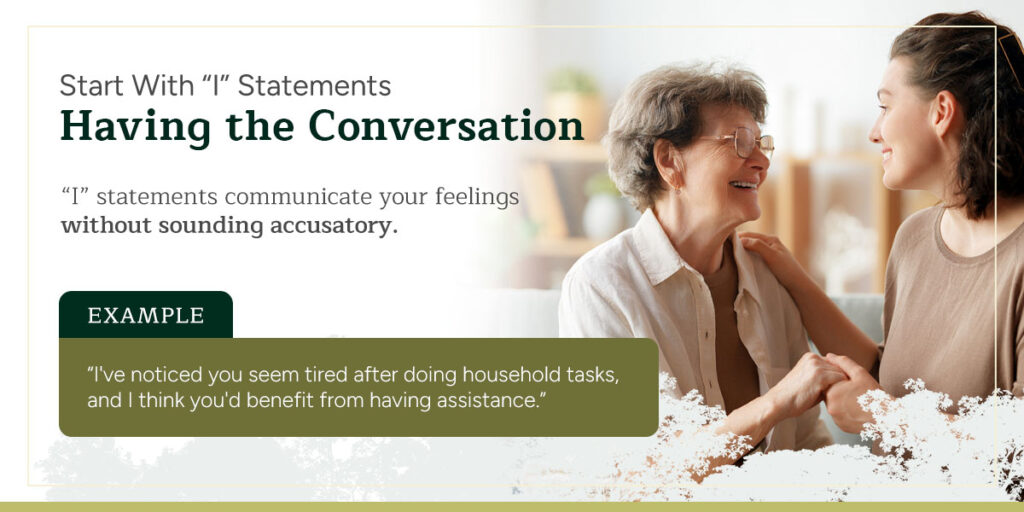
“I” statements communicate your feelings without sounding accusatory, while “you” statements can come across as overly critical. Instead of saying, “You can’t manage at home anymore,” try, “I worry about you handling the stairs alone.” This phrasing shifts the conversation from pointing out signs your parents need personal care to collaborating on solutions.
Here are some ways to initiate the talk:
These approaches to talking to the elderly about personal care invite dialogue rather than defensiveness.
When talking with your parents about personal care, structure the conversation around what they’ll gain, not what they might lose. These communities offer meaningful advantages that can make daily life easier, safer and more enjoyable.
Listen without interrupting or trying to immediately solve every concern. Often, people need to voice their feelings before they are open to considering solutions. Acknowledge what you hear and avoid dismissing their emotions. You don’t need to decide in one conversation, so give your parents time to process and let them know you’re available to continue talking whenever they’re ready.
Your ability to respond calmly in the face of pushback will keep the conversation productive. Here are examples of how to address your parents’ concerns.
Don’t rush into talking to your aging parents about moving right away. Instead, start with low-pressure steps that let your parents explore personal care at their preferred pace.
Ask which features matter most to them in a community. For example, would they prefer a smaller, quieter setting? Suggest looking at websites or reading brochures together. A virtual tour lets them see what communities look like, without commitment.
Take it one step at a time. When they’re ready, you can consider experiencing communities in person.
When choosing communities to tour, Elm Terrace in Lansdale is worth considering. We’re a nonprofit continuing care retirement community where personal care focuses on your parents’ independence and individual needs.
We invite you to visit and let us treat you to lunch! Chat with the residents and experience the spaces and services that help people feel at home. Getting a genuine feel for what life here is like can help you and your parents continue the conversation about transitioning to personal care.
Call us at 215-361-5600 or fill out our online form to schedule your tour.